
TrueScaleAudio
Compare speakers at true scale
Pick two speakers and see them side by side at their real-world size.
Front view — side by side at true scale
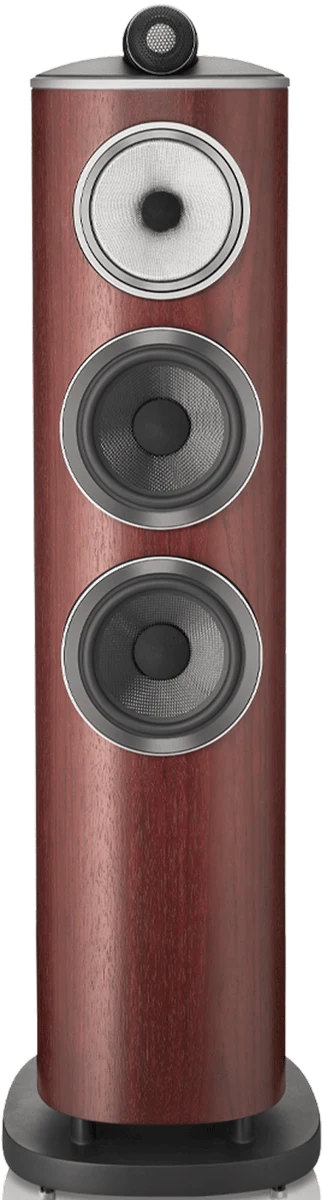
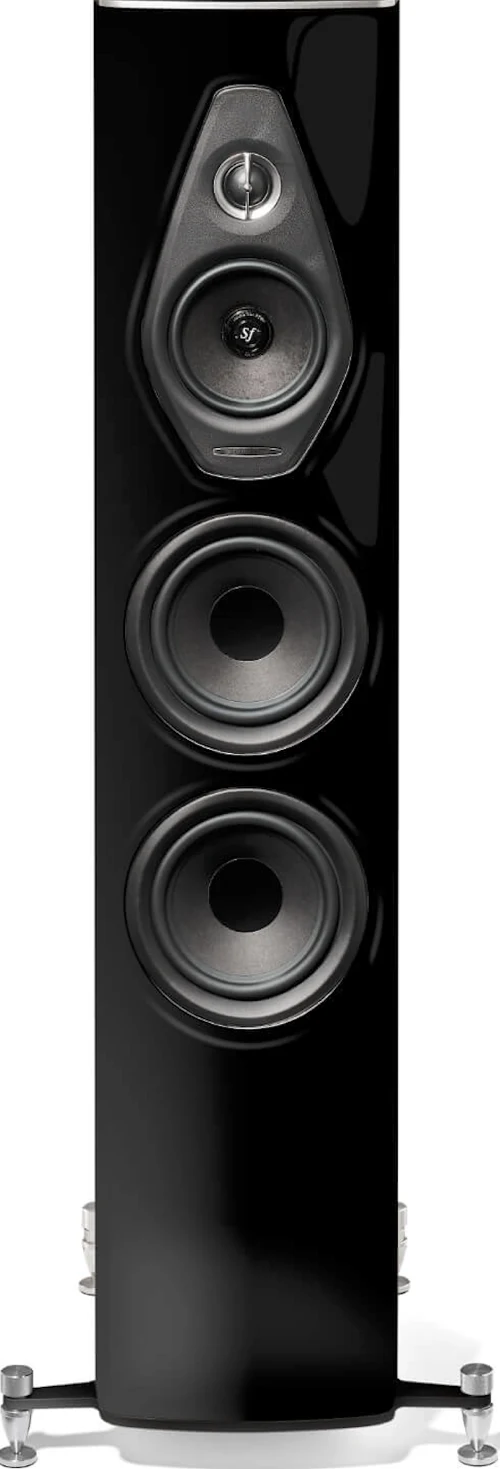
Click either cabinet to swap A ↔ B · Reference height: 1104 mm (110.4 cm) · 1 mm = 0.51 px
Bowers & Wilkins 804 D4vsSonus Faber Olympica Nova III
The Sonus Faber Olympica Nova III stands 110.4 cm tall — about 3.3 cm more than the Bowers & Wilkins 804 D4 at 107.1 cm. On footprint the Sonus Faber Olympica Nova III is the wider cabinet (36.3 cm versus 28.8 cm). At 90 dB against 89 dB, the Sonus Faber Olympica Nova III is the easier load to drive and plays louder from the same amplifier. The Bowers & Wilkins 804 D4 reaches deeper in the bass, down to 24 Hz versus 35 Hz. Low frequencies come from a 165 mm cone on the Bowers & Wilkins 804 D4 and a 180 mm cone on the Sonus Faber Olympica Nova III. Both land in a similar price bracket, around $12,750 a pair.
| A | B | |
|---|---|---|
| Manufacturer | Bowers & Wilkins | Sonus Faber |
| Model | 804 D4 | Olympica Nova III |
| HiFi ladder position | #249 of 601 floorstander | #303 of 601 floorstander |
| Height | 1071 mm | 1104 mm |
| Width | 288 mm | 363 mm |
| Depth | 391 mm | 459 mm |
| Weight | 36.85 kg | 35 kg |
| Enclosure | bass-reflex-down | bass-reflex-rear |
| Drivers | 1× 25 mm tweeter (diamond dome), 1× 130 mm midrange (Continuum cone with FST surround), 2× 165 mm woofer (Aerofoil cone) | 1× 28 mm tweeter (H28 XTR3 soft dome with DAD), 1× 150 mm midrange (MW15 paper cone), 2× 180 mm woofer (W18 paper cone) |
| Crossover frequency | — | 250 / 2500 Hz |
| Frequency — low | 24 Hz | 35 Hz |
| Frequency — high | 28000 Hz | 35000 Hz |
| Sensitivity | 89 dB | 90 dB |
| Impedance | 8 Ω | 4 Ω |
| Recommended amp | 50–200 W | 50–300 W |
| MAP (USD) | $13,000 / pair | $12,500 / pair |
| Where to buy | Check availability ↗ | Check availability ↗ |
| Brand website | bowerswilkins.com ↗ | sonusfaber.com ↗ |
| Product page | Open product page ↗ | Open product page ↗ |
Larger value highlighted in green. For low-frequency extension, lower Hz = greater bass reach, so the deeper side is highlighted.