
TrueScaleAudio
Compare speakers at true scale
Pick two speakers and see them side by side at their real-world size.
Front view — side by side at true scale
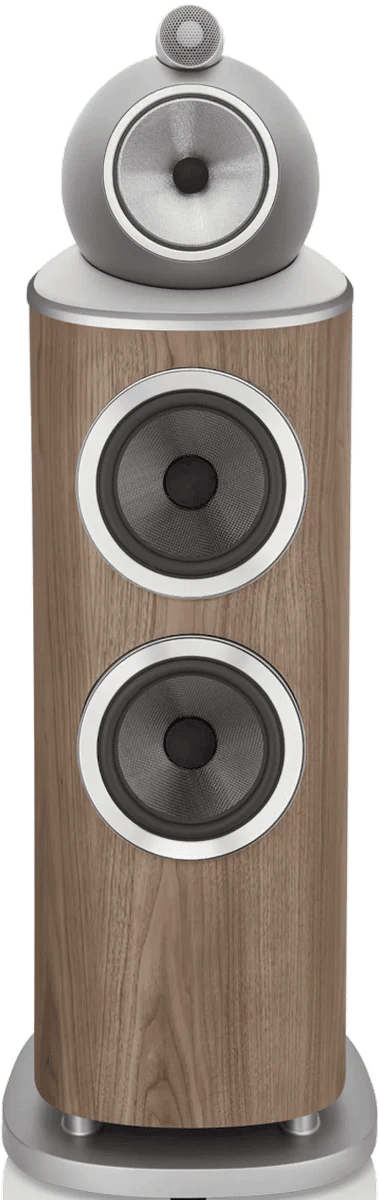
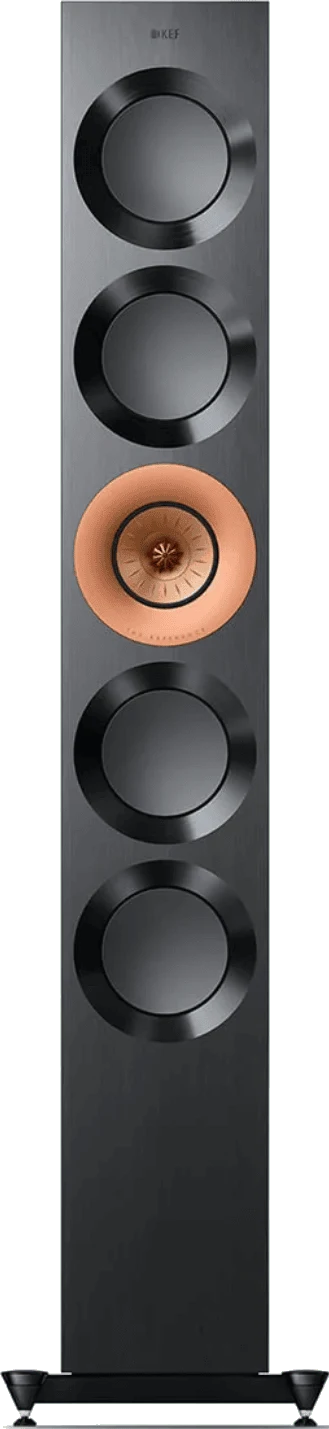
Click either cabinet to swap A ↔ B · Reference height: 1402 mm (140.2 cm) · 1 mm = 0.40 px
Plan view — footprint at true scale
A shelf applies to bookshelf speakers only — one of these stands on the floor.
Seen from above, both pushed back to the same front wall — the wall behind the speakers. Only height, width and depth are published, so each cabinet is drawn as a rectangle: this is the surface a speaker reserves, not its exact outline. A curved or tapered cabinet takes a little less. How far a speaker should sit from the wall is yours to set: makers rarely publish it, and the ones that do disagree by design.
Performance — where each one sits in the catalog
| Bass reach | Treble reach | Sensitivity | Easy load | Cone area | |
|---|---|---|---|---|---|
| 802 D4 | 17 Hz | 28 kHz | 90 dB | 8 Ω | 810 cm² |
| Reference 5 Meta | 40 Hz | 35 kHz | 88 dB | 4 Ω | 983 cm² |
| Median | 32 Hz | 30 kHz | 90 dB | 6 Ω | 654 cm² |
How to read this chart
Each axis spans the range the 648 floorstanders in the catalog actually cover, so equal distance means equal difference — and for cone area and the two frequencies, which are read as ratios, equal distance means equal ratio. The dashed inner ring is where the scale starts, not zero. Ranked within a class because a bookshelf measured against floorstanders is feeble on every axis for the single reason that it is a bookshelf. Cone area is summed from the drive units — no maker publishes it. Bass and treble reach are quoted to different tolerances and only 56% of the catalog says which, so read those two axes as approximate. The grey outline is the median of the pair's own class, the 600 passive floorstanders — same type, same side of the active/passive line, which matters because the two halves are not the same product: the median active bookshelf carries 155 cm² of cone against the passive median's 219. Median rather than mean, because a handful of very large cabinets would drag a mean above most of the class it claims to describe.
Bowers & Wilkins 802 D4vsKEF Reference 5 Meta
The KEF Reference 5 Meta stands 140.2 cm tall — about 18.4 cm more than the Bowers & Wilkins 802 D4 at 121.8 cm. On footprint the Bowers & Wilkins 802 D4 is the wider cabinet (38.5 cm versus 32.3 cm). At 90 dB against 88 dB, the Bowers & Wilkins 802 D4 is the easier load to drive and plays louder from the same amplifier. The Bowers & Wilkins 802 D4 reaches deeper in the bass, down to 17 Hz versus 40 Hz. Low frequencies come from a 200 mm cone on the Bowers & Wilkins 802 D4 and a 165 mm cone on the KEF Reference 5 Meta. On price, the Bowers & Wilkins 802 D4 sits higher — about $24,000 a pair against $19,998 for the KEF Reference 5 Meta.
| A | B | |
|---|---|---|
| Manufacturer | Bowers & Wilkins | KEF |
| Model | 802 D4 | Reference 5 Meta |
| HiFi ladder position | #469 of 648 floorstander | #574 of 648 floorstander |
| Height | 1218 mm | 1402 mm |
| Width | 385 mm | 323 mm |
| Depth | 602 mm | 467 mm |
| Footprint | 2318 cm² | 1508 cm² |
| Space taken | 282.3 L | 211.5 L |
| Weight | 88.1 kg | 60.2 kg |
| Enclosure | bass-reflex-down | bass-reflex-rear |
| Drivers | 1× 25 mm tweeter (diamond dome), 1× 150 mm midrange (Continuum cone with FST surround), 2× 200 mm woofer (Aerofoil cone) | 1× 25 mm tweeter (MAT aluminium dome), 1× 125 mm midrange (aluminium cone), 4× 165 mm woofer (aluminium cone) |
| Crossover frequency | — | 450 / 2100 Hz |
| Frequency — low | 17 Hz | 40 Hz |
| Frequency — high | 28000 Hz | 35000 Hz |
| Sensitivity | 90 dB | 88 dB |
| Impedance | 8 Ω | 4 Ω |
| Recommended amp | 50–500 W | 50–400 W |
| MAP (USD) | $24,000 / pair | $19,998 / pair |
| Where to buy | Check availability ↗ | Check availability ↗ |
| Brand website | bowerswilkins.com ↗ | international.kef.com ↗ |
| Product page | Open product page ↗ | Open product page ↗ |
Larger value highlighted in green. For low-frequency extension, lower Hz = greater bass reach, so the deeper side is highlighted.