
TrueScaleAudio
Compare speakers at true scale
Pick two speakers and see them side by side at their real-world size.
Front view — side by side at true scale
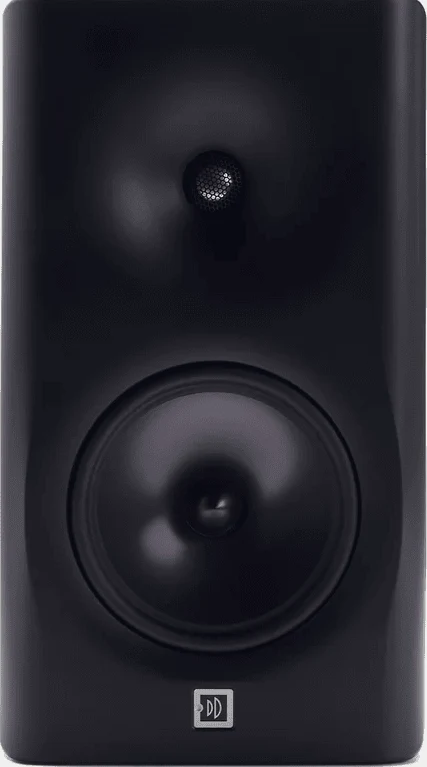

Click either cabinet to swap A ↔ B · Reference height: 485 mm (48.5 cm) · 1 mm = 1.15 px
Plan view — footprint at true scale
Seen from above, both pushed back to the same front wall — the wall behind the speakers. Only height, width and depth are published, so each cabinet is drawn as a rectangle: this is the surface a speaker reserves, not its exact outline. A curved or tapered cabinet takes a little less. How far a speaker should sit from the wall is yours to set: makers rarely publish it, and the ones that do disagree by design.
Performance — where each one sits in the catalog
| Bass reach | Treble reach | Cone area | |
|---|---|---|---|
| 8c | 30 Hz | 20 kHz | 947 cm² |
| HS8 | 38 Hz | 30 kHz | 329 cm² |
| Median | 39 Hz | 24 kHz | 332 cm² |
How to read this chart
Each axis spans the range the 114 studio monitors in the catalog actually cover, so equal distance means equal difference — and for cone area and the two frequencies, which are read as ratios, equal distance means equal ratio. The dashed inner ring is where the scale starts, not zero. Ranked within a class because a bookshelf measured against floorstanders is feeble on every axis for the single reason that it is a bookshelf. Cone area is summed from the drive units — no maker publishes it. Bass and treble reach are quoted to different tolerances and only 56% of the catalog says which, so read those two axes as approximate. The grey outline is the median of the pair's own class, the 96 active studio monitors — same type, same side of the active/passive line, which matters because the two halves are not the same product: the median active bookshelf carries 155 cm² of cone against the passive median's 219. Median rather than mean, because a handful of very large cabinets would drag a mean above most of the class it claims to describe. Not shown: Sensitivity, Easy load — neither maker publishes a figure. Active speakers quote no sensitivity and no impedance, because with the amplifier inside both describe the electronics rather than the cabinet.
Dutch & Dutch 8cvsYamaha HS8
The Dutch & Dutch 8c stands 48.5 cm tall — about 9.5 cm more than the Yamaha HS8 at 39.0 cm. On footprint the Dutch & Dutch 8c is the wider cabinet (27.0 cm versus 25.0 cm). The Dutch & Dutch 8c reaches deeper in the bass, down to 30 Hz versus 38 Hz. The Dutch & Dutch 8c is a sealed cabinet and the Yamaha HS8 is rear-ported. On price, the Dutch & Dutch 8c sits higher — about $13,400 a pair against $339 for the Yamaha HS8.
| A | B | |
|---|---|---|
| Manufacturer | Dutch & Dutch | Yamaha |
| Model | 8c | HS8 |
| HiFi ladder position | #71 of 114 floorstander | #58 of 114 floorstander |
| Height | 485 mm | 390 mm |
| Width | 270 mm | 250 mm |
| Depth | 380 mm | 334 mm |
| Footprint | 1026 cm² | 835 cm² |
| Space taken | 49.8 L | 32.6 L |
| Weight | 26 kg | 10.2 kg |
| Enclosure | sealed | bass-reflex-rear |
| Drivers | 1× 25 mm tweeter (aluminium-magnesium alloy dome), 1× 200 mm midrange (aluminium cone), 2× 200 mm woofer (aluminium cone) | 1× 25 mm tweeter (soft dome), 1× 203 mm woofer (cone) |
| Crossover frequency | 100 / 1250 Hz | 2000 Hz |
| Frequency — low | 30 Hz | 38 Hz |
| Frequency — high | 20000 Hz | 30000 Hz |
| Sensitivity | — | — |
| Impedance | — | — |
| Recommended amp | — | — |
| MAP (USD) | $13,400 / pair | $339.14 each |
| Where to buy | Check availability ↗ | Check on Amazon ↗ |
| Brand website | dutchdutch.com ↗ | usa.yamaha.com ↗ |
| Product page | Open product page ↗ | Open product page ↗ |
Larger value highlighted in green. For low-frequency extension, lower Hz = greater bass reach, so the deeper side is highlighted.