
TrueScaleAudio
Compare speakers at true scale
Pick two speakers and see them side by side at their real-world size.
Front view — side by side at true scale

Click either cabinet to swap A ↔ B · Reference height: 1352 mm (135.2 cm) · 1 mm = 0.41 px
Plan view — footprint at true scale
A shelf applies to bookshelf speakers only — one of these stands on the floor.
Seen from above, both pushed back to the same front wall — the wall behind the speakers. Only height, width and depth are published, so each cabinet is drawn as a rectangle: this is the surface a speaker reserves, not its exact outline. A curved or tapered cabinet takes a little less. How far a speaker should sit from the wall is yours to set: makers rarely publish it, and the ones that do disagree by design.
Performance — where each one sits in the catalog
| Bass reach | Treble reach | Sensitivity | Easy load | Cone area | |
|---|---|---|---|---|---|
| R5 Meta | 52 Hz | 28 kHz | 87 dB | 4 Ω | 393 cm² |
| Klipschorn AK7 | 34 Hz | 19 kHz | 103 dB | 8 Ω | 1165 cm² |
| Median | 32 Hz | 30 kHz | 90 dB | 6 Ω | 654 cm² |
How to read this chart
Each axis spans the range the 648 floorstanders in the catalog actually cover, so equal distance means equal difference — and for cone area and the two frequencies, which are read as ratios, equal distance means equal ratio. The dashed inner ring is where the scale starts, not zero. Ranked within a class because a bookshelf measured against floorstanders is feeble on every axis for the single reason that it is a bookshelf. Cone area is summed from the drive units — no maker publishes it. Bass and treble reach are quoted to different tolerances and only 56% of the catalog says which, so read those two axes as approximate. The grey outline is the median of the pair's own class, the 600 passive floorstanders — same type, same side of the active/passive line, which matters because the two halves are not the same product: the median active bookshelf carries 155 cm² of cone against the passive median's 219. Median rather than mean, because a handful of very large cabinets would drag a mean above most of the class it claims to describe.
KEF R5 MetavsKlipsch Klipschorn AK7
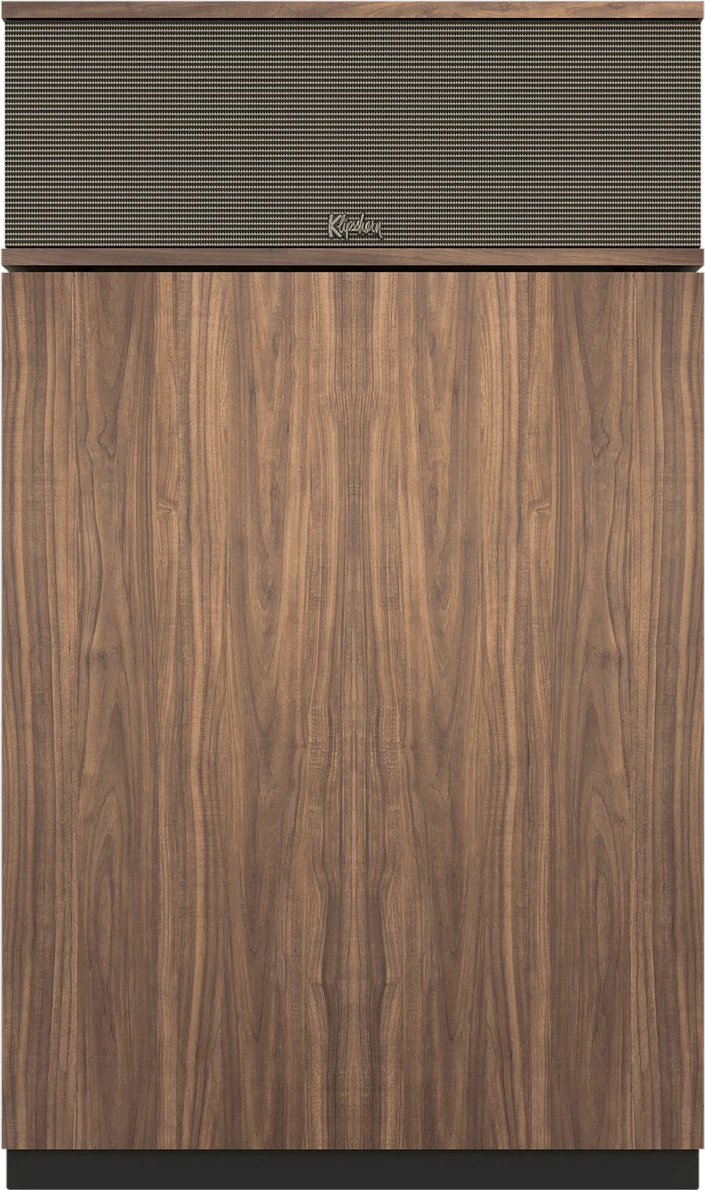
The Klipsch Klipschorn AK7 stands 135.2 cm tall — about 28.0 cm more than the KEF R5 Meta at 107.2 cm. On footprint the Klipsch Klipschorn AK7 is the wider cabinet (80.1 cm versus 26.9 cm). At 103 dB against 87 dB, the Klipsch Klipschorn AK7 is the easier load to drive and plays louder from the same amplifier. The Klipsch Klipschorn AK7 reaches deeper in the bass, down to 34 Hz versus 52 Hz. Low frequencies come from a 130 mm cone on the KEF R5 Meta and a 381 mm cone on the Klipsch Klipschorn AK7. On price, the Klipsch Klipschorn AK7 sits higher — about $19,998 a pair against $5,999 for the KEF R5 Meta.
| A | B | |
|---|---|---|
| Manufacturer | KEF | Klipsch |
| Model | R5 Meta | Klipschorn AK7 |
| HiFi ladder position | #262 of 648 floorstander | #556 of 648 floorstander |
| Height | 1072 mm | 1352 mm |
| Width | 269 mm | 801 mm |
| Depth | 344 mm | 715 mm |
| Footprint | 925 cm² | 5727 cm² |
| Space taken | 99.2 L | 774.3 L |
| Weight | 24.5 kg | 118 kg |
| Enclosure | bass-reflex-rear | — |
| Drivers | 1× 25 mm tweeter (MAT aluminium dome), 1× 125 mm midrange (aluminium cone), 2× 130 mm woofer (hybrid aluminium cone) | 1× 25 mm tweeter (K-771 compression diaphragm), 1× 51 mm midrange (K-933-HP compression diaphragm), 1× 381 mm woofer (K-33-E fiber-composite cone) |
| Crossover frequency | 400 / 2700 Hz | 380 / 2900 Hz |
| Frequency — low | 52 Hz | 34 Hz |
| Frequency — high | 28000 Hz | 19000 Hz |
| Sensitivity | 87 dB | 103 dB |
| Impedance | 4 Ω | 8 Ω |
| Recommended amp | 15–200 W | — |
| MAP (USD) | $5,999 / pair | $19,998 / pair |
| Where to buy | Check on Amazon ↗ | Check availability ↗ |
| Brand website | international.kef.com ↗ | klipsch.com ↗ |
| Product page | Open product page ↗ | Open product page ↗ |
Larger value highlighted in green. For low-frequency extension, lower Hz = greater bass reach, so the deeper side is highlighted.