
TrueScaleAudio
Compare speakers at true scale
Pick two speakers and see them side by side at their real-world size.
Front view — side by side at true scale

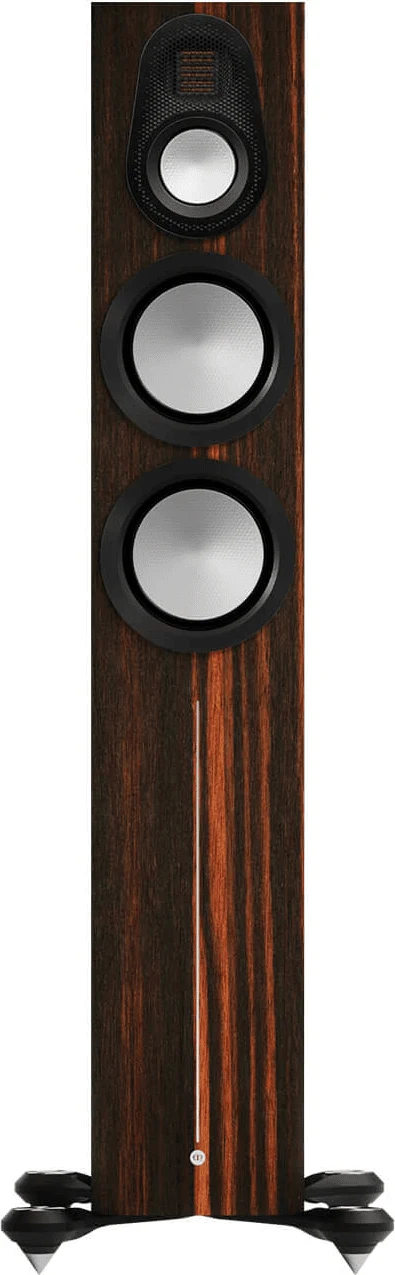
Click either cabinet to swap A ↔ B · Reference height: 1098 mm (109.8 cm) · 1 mm = 0.51 px
Plan view — footprint at true scale
A shelf applies to bookshelf speakers only — one of these stands on the floor.
Seen from above, both pushed back to the same front wall — the wall behind the speakers. Only height, width and depth are published, so each cabinet is drawn as a rectangle: this is the surface a speaker reserves, not its exact outline. A curved or tapered cabinet takes a little less. How far a speaker should sit from the wall is yours to set: makers rarely publish it, and the ones that do disagree by design.
Performance — where each one sits in the catalog
| Bass reach | Treble reach | Sensitivity | Easy load | |
|---|---|---|---|---|
| Reference 7 | 23 Hz | 40 kHz | 87.5 dB | 4 Ω |
| Gold 300 | 28 Hz | 60 kHz | 87 dB | 4 Ω |
| Median | 32 Hz | 30 kHz | 90 dB | 6 Ω |
How to read this chart
Each axis spans the range the 648 floorstanders in the catalog actually cover, so equal distance means equal difference — and for cone area and the two frequencies, which are read as ratios, equal distance means equal ratio. The dashed inner ring is where the scale starts, not zero. Ranked within a class because a bookshelf measured against floorstanders is feeble on every axis for the single reason that it is a bookshelf. Cone area is summed from the drive units — no maker publishes it. Bass and treble reach are quoted to different tolerances and only 56% of the catalog says which, so read those two axes as approximate. The grey outline is the median of the pair's own class, the 600 passive floorstanders — same type, same side of the active/passive line, which matters because the two halves are not the same product: the median active bookshelf carries 155 cm² of cone against the passive median's 219. Median rather than mean, because a handful of very large cabinets would drag a mean above most of the class it claims to describe. Not shown: Cone area — published by only one of the two. An outline reaching one more vertex than its neighbour reads as the bigger speaker when the only difference is which maker filled in a spec sheet. The figure is still in the table below.
Canton Reference 7vsMonitor Audio Gold 300
The Monitor Audio Gold 300 stands 109.8 cm tall — about 10.8 cm more than the Canton Reference 7 at 99.0 cm. On footprint the Monitor Audio Gold 300 is the wider cabinet (33.9 cm versus 25.7 cm). The Canton Reference 7 reaches deeper in the bass, down to 23 Hz versus 28 Hz. The Canton Reference 7 is down-firing ported and the Monitor Audio Gold 300 is rear-ported. On price, the Canton Reference 7 sits higher — about $8,500 a pair against $6,199 for the Monitor Audio Gold 300.
| A | B | |
|---|---|---|
| Manufacturer | Canton | Monitor Audio |
| Model | Reference 7 | Gold 300 6G |
| HiFi ladder position | #126 of 648 floorstander | #295 of 648 floorstander |
| Height | 990 mm | 1098 mm |
| Width | 257 mm | 339 mm |
| Depth | 430 mm | 463 mm |
| Footprint | 1105 cm² | 1570 cm² |
| Space taken | 109.4 L | 172.3 L |
| Weight | 33 kg | 21.2 kg |
| Enclosure | bass-reflex-down | bass-reflex-rear |
| Drivers | 1× 25 mm tweeter (aluminium-oxide ceramic dome), 1× 154 mm midrange (Black Ceramic Tungsten cone), 2× 154 mm woofer (Black Ceramic Tungsten cone) | 1× tweeter (MPD III (Air Motion Transformer)), 1× 76 mm midrange (HDT C-CAM), 2× 152 mm woofer (HDT C-CAM) |
| Crossover frequency | 190 / 3200 Hz | 800 / 2700 Hz |
| Frequency — low | 23 Hz | 28 Hz |
| Frequency — high | 40000 Hz | 60000 Hz |
| Sensitivity | 87.5 dB | 87 dB |
| Impedance | 4 Ω | 4 Ω |
| Recommended amp | — | 130–500 W |
| MAP (USD) | $8,500 / pair | $6,199 / pair |
| Where to buy | Check availability ↗ | Check availability ↗ |
| Brand website | canton.de ↗ | monitoraudio.com ↗ |
| Product page | Open product page ↗ | Open product page ↗ |
Larger value highlighted in green. For low-frequency extension, lower Hz = greater bass reach, so the deeper side is highlighted.